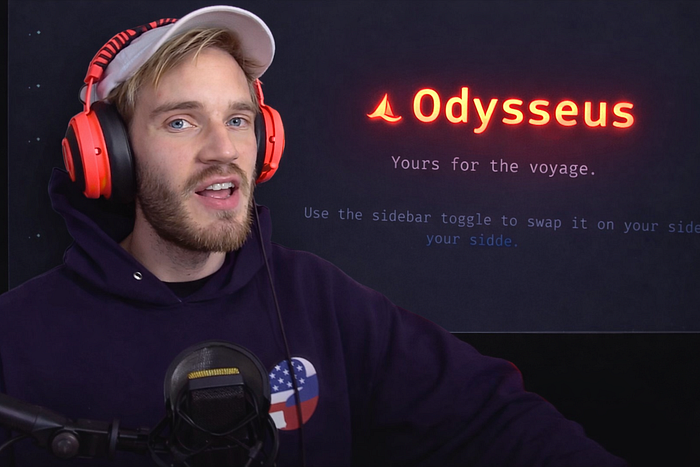


PewDiePie Odysseus AI | Free AI Workspace 2026 | Self Hosted AI
Read here for FREE
Most people are paying $20 a month for AI tools they don't fully own and can't fully control. PewDiePie just built something that tries to change that.
On May 31, 2026, Felix Kjellberg released Odysseus, a free and open-source AI workspace you run entirely on your own machine.
He called it his trillion dollar project.
It collected over 30,000 GitHub stars within 48 hours of launch. For comparison, most funded startups never reach that number in a full year.
He spent about a year building this, and he did it publicly. He documented the whole process on YouTube, fine-tuned a language model that outperformed GPT-4o on coding benchmarks, built a data collection system he called The Swarm, and eventually put it all together into something anyone can download and use for free.
What Odysseus Actually Is
Odysseus is not a new AI model. It does not have its own intelligence baked in.
It is an interface. Think of it as a dashboard you install on your own computer, then point at whatever AI model you want to use. That model can be one running locally on your own hardware, or it can be an external API like Claude or ChatGPT.
The official description puts it plainly: a self-hosted interface for talking to language models, with chat, autonomous agents, tools, email, research, and more. Local-first, privacy-first, no telemetry.
Simpler version: it gives you the ChatGPT-style experience but hosted on your machine, not on OpenAI's servers.
What It Can Do
Odysseus bundles a lot into one workspace.
Here is what actually ships with it:
- Chat with any local model or cloud API
- Autonomous agents that can browse the web, edit files, and run tasks on your behalf
- Deep Research, a multi-step mode that gathers and synthesizes sources into a full written report
- Email assistant with AI-generated summaries and draft replies via standard email protocols
- Calendar and notes integration
- Document editing and file uploads
- Persistent memory that carries context across separate conversations
- Image generation
- Model comparison to test outputs from multiple AIs side by side
And then there is the Cookbook.
The Cookbook Feature
This is the most practically useful thing Odysseus adds, especially if you are new to local AI.
Most people who try running AI on their own hardware hit the same wall early. They do not know which models will actually work with their setup. Download something too large and it either crashes or runs so slowly it is pointless.
Cookbook removes that friction.
It scans your computer's hardware, figures out how much memory and processing power you have, and recommends models from a catalog of over 270 options that will actually run on your machine. You click download. It handles the rest.
For smaller models, a recent laptop with 16GB of RAM can work. Larger, more capable models need a dedicated GPU with at least 8 to 12GB of VRAM. The Cookbook figures that out for you automatically.
The Privacy Promise, and What It Actually Means
This is the main selling point, so it is worth being clear about.
When Odysseus runs with a local model, your conversations stay on your machine. Nothing gets sent to external servers. No subscriptions, no data collection, no tracking.
But there is a catch worth understanding.
If you connect Odysseus to a cloud API like ChatGPT or Claude to get stronger responses, your data goes to those companies' servers. That is just how those APIs work. The privacy promise only holds when you are actually running local models.
PewDiePie's own setup runs on a $20,000 rig with eight GPUs. His local experience is significantly more capable than what most people have at home. If you run it on a standard laptop, the quality gap compared to his demo will be noticeable.
The Honest Concerns
A real review has to include the problems. There are a few worth knowing about before you install anything.
It is vibecoded.
Vibecoded means the code was largely generated by AI tools quickly, without deep architectural review or security sandboxing. A cybersecurity researcher named Jamieson O'Reilly published a detailed breakdown flagging several vulnerabilities in the codebase. The Odysseus website itself admits the project was born from a prompt that refused to stop, and parts of the code were written from a phone. Because Odysseus agents can access your files, run shell commands, and browse the web, those vulnerabilities carry more weight than they would in a simple chat app.
It is not plug-and-play.
You will need Docker installed, basic comfort with a terminal, and patience. Getting it running takes more than a few minutes. Complete beginners will likely hit a wall.
More mature alternatives already exist.
Open WebUI, LibreChat, and AnythingLLM have been around longer, have more stable code, better documentation, and larger communities. The first question that surfaced in early Hacker News discussion about Odysseus was: why use this instead of Open WebUI? That is a fair question. Right now, Odysseus does not have a clear technical edge over those tools.
Early user reviews are Also mixed.
One more thing worth noting: there is no native macOS or Windows app. Odysseus runs in your browser as a locally hosted web UI. That is fine once it is set up, but it adds another layer to the initial experience.
Who This Is Actually For
Odysseus makes sense if you:
- Care about where your data goes and want actual control over it
- Are comfortable with a basic technical setup
- Want chat, agents, research, email, and productivity tools bundled into one place without stitching multiple apps together
- Are curious about local AI and want a cleaner starting point than building from scratch
It is probably not the right fit if you:
- Want something that works immediately with no setup
- Need production stability and mature documentation
- Are a complete beginner looking for a direct ChatGPT replacement
The Bigger Picture
The 44,000 GitHub stars Odysseus collected in just a few days after launch say something real. They are not just from PewDiePie's audience. They reflect a frustration that has been building for a while: AI tools are increasingly locked behind monthly subscriptions, dependent on company servers, and vague about what happens to your data.
PewDiePie has over 110 million YouTube subscribers. No average open-source project gets that kind of distribution. That reach means Odysseus is landing in front of people who have never heard of self-hosted AI before, and for some of them, it will be the first time the concept clicks.
Odysseus does not fully solve the problem it is pointing at. It is rough in places, early in development, and technically outpaced by more mature tools in certain areas. But it is free. It is open-source. The code is inspectable and modifiable by anyone. And it ships as a complete workspace rather than something you have to assemble from separate pieces.
For someone who wants more control over their AI setup and is willing to spend a bit of time on it, it is genuinely worth trying.
If you are a writer, we'd love to have you!!! Join us and share your stories.