
Linux is a polarizing topic in the tech space. Any time someone posts on social media about a problem with Windows or (more rarely) macOS, invariably some tryhard pops into the conversation with "Just use Linux lol."
Yes. Thank you, Kevin. Let the adults talk please. Thanks.
But maybe Kevin had more of a point than I once gave him credit for.
At one time, I saw Linux as just a toy or as something that was reserved for smelly basement dwellers, not serious computer users. I thought that Linux was slang for "lives with his mom and has no friends."
I couldn't have been more wrong.
But wrong ideas like mine are sadly common, and I dare say that the odds are good you've bought into a few of these too.
Let's talk about them.
"Linux? You mean Terminal Simulator 3000?"
Linux pros know that the terminal is one of the oldest and best tools in the OS. With it, you can do just about anything. Installing apps. Removing apps. Changing settings. Even causing the OS to self destruct before you reinstall (which is kinda fun to watch).
At one time, doing even basic things relied heavily on the terminal.
I've mentioned it a few times, but I remember fondly trying to get Wi-Fi working on my then-current 2007/2008 MacBook Pro with Ubuntu 7.10. That was fun. I fumbled my way through it with a lot of help from Google, but it was a project.
In 2026, the big distros have largely reached terminal independence. Users are free to use it if they'd like, but a great majority of the time they don't even have to know it exists.
That's not to say that it doesn't have a use, and that's not to say that there aren't times when the fastest and easiest method is to open a terminal and type or paste in a command or two.
To a degree, that's true with Windows too.
I work in IT and manage systems for clients. Sometimes the fastest and sometimes the only way to do something is through PowerShell or Windows Terminal.
So Windows, you don't score here either. Sorry.
However, this is an area that Linux as a whole needs to improve if it's going to seriously take on Windows and macOS on the desktop. It's come a long way, but it's not quite "grandma proof" just yet.
But neither is it Terminal Simulator 3000 anymore. Day to day, I don't touch the terminal. At all.
"You can't game on Linux!"
Windows has been the undisputed king of gaming for decades. If a new game is released, odds are it's going to run on Windows. It might work on Linux.
Macs? Sorry. I know Apple is working to correct that. (To be fair, some Steam games do support macOS too, which is nice to see.)
But it's been a long standing trope that Linux can't game. If you want to game, you need Windows.
At one time, that was true. Gaming and Linux would only fit together in a sentence along the lines of "Linux isn't good for gaming."
The games that could run on Linux were the free-for-a-reason, low quality sort that lots of gamers wouldn't have been interested in anyway.
That's not true today though. Thanks in no small part to WINE, Proton (from Valve), Lutris, and a variety of other tools, gaming on Linux is not only possible these days, but easy.
My main gaming system runs Ubuntu 24.04 with an RTX 5070 Ti and 64GB of RAM. It works beautifully.
Clair Obscur: Expedition 33, Deep Rock Galactic, Helldivers 2, No Man's Sky… a bunch of the games I play… actually work amazingly well on Linux now.
An October 2025 report from Tom's Hardware showed that around 90% of Windows games work on Linux these days. That's significant.
Now obviously that 90% figure isn't 100%, and that means that there are games that you might want to play that don't work on Linux and probably never will.
Games that require kernel-level anti-cheats are most likely never coming to Linux. But some anti-cheat software does work just fine, so games like Helldivers 2 are good to go.
Certainly I won't say that Linux is the best choice for every gamer, especially those who want to play games like Battlefield 6.
But more and more, it's an excellent choice. After all, even Valve's own gaming handheld, the Steam Deck, runs Linux.
There's something to that.
"Linux is hard to install."
Back in the dark ages, when I was first really playing with Linux installations, I remember having to wade through confusing installers and settings that I'd never heard of.
Which file system should I pick? What's "swap?" How much should I give it? Wait, what's a bootloader? I don't know where that should go…
It was fun. I had to do a bit of research to get it all set up, coming from a Windows background. To install Windows XP or Vista or 7, all I had to do was boot up from installation media, click Next a bunch of times, and wait.
Linux? Not so much.
That too, has changed over the years. It's now just as easy to install Linux as it is to install Windows, in my opinion. The modern distros have greatly simplified this process to the point that even someone who isn't tech savvy could get through it easily.
And if you're not sure you're ready to install, you can even run most Linux distros straight from a USB drive without ever touching your files or Windows installation.

"Linux is a techie side project."
One of the benefits of Linux is that it's not the product of a single corporation, like Microsoft, pulling the strings and beholden to the demands of shareholders.
It's the product of thousands of developers, from volunteers to full-time professionals, all around the world. It's the product of major collaborative effort and coordination by teams big and small.
But it's hardly a grass-roots-only, tech-bro side project.
There are hundreds of distributions of Linux. Some massive, like Debian. Some small, like Nobara.
The tiny, community-based distros are often maintained by just a few people, or even a single person. Those are, arguably "techie side projects." But that doesn't mean they're not stable, secure and fun to use.
Others, like Ubuntu, have many hundreds of contributors. The Debian project, from which Ubuntu takes much of its DNA, has over 1,000.
Several distributions have corporate backing and investment as well, which is a strong consideration for businesses and corporations looking for a long-lasting, stable project to rely on.
Ubuntu is backed by Canonical. Fedora and Red Hat Enterprise Linux (or RHEL), by Red Hat. OpenSUSE, by SUSE. Oracle Linux by Oracle. And so on.
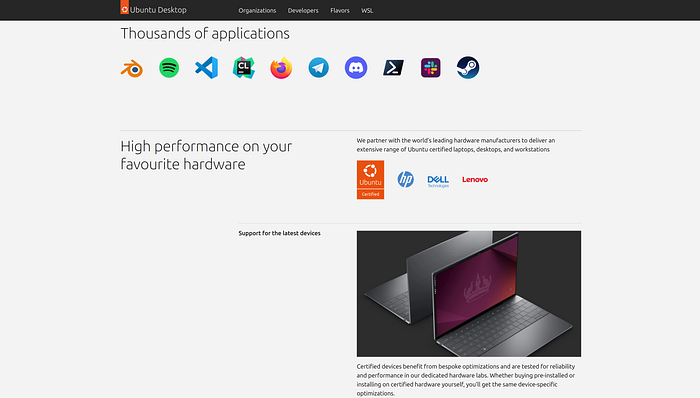
Several of the major distros are also sponsored by and partnered with many of the big names, like Amazon, Google, Qualcomm, VMware, Intel, HP, Dell, NVIDIA, Lenovo, and so on.
Dell, HP, and Lenovo even offer models with Ubuntu preinstalled.
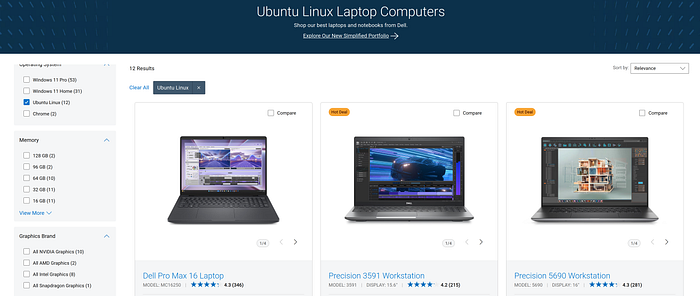
Fedora has its own partners as well. System76, a hardware vendor, offers its own distro, Pop!_OS.
Much could be said about these partnerships and sponsorships. But the support is strong, both from individuals and volunteers and larger entities as well.
Linux might have started as a Comp-Sci student's side project. But it's grown into a massive platform that powers 100% of the world's supercomputers, 50–60% of servers, and an increasing percentage of the desktop market.
A tiny project it ain't.
"Linux is too fragmented and confusing."
Linux comes in a huge array of flavors called distributions, or "distros." Each offers its own set of preinstalled apps, packages, themes, and so on.
Some are clean and utilitarian, like Linux Mint. Others focus more on eye candy and visual effects.
Some are purpose built, and designed for specific scenarios. Others are intended to be general use operating systems on the level of macOS and Windows.
But at the core of them all is the same base: the Linux kernel.
It's very true that someone switching to Linux at first is likely to be overwhelmed by all the options. I get it.
Should you go with Ubuntu or Linux Mint or Fedora or Arch or Cachy OS or Pop!_OS or Manjaro or…. You get the picture. There are so many to pick from.
That's why I recommend downloading a few and trying them out on a USB drive first before even considering installing one on your computer. I find that sort of stuff fun. If you don't find that sort of thing fun and don't want to have to try a bunch to make a decision, just go with Ubuntu. It's hard to go wrong there.
This variety is one of the strengths of Linux. No matter your preferences, there's most likely a distribution that suits your needs and what you like. And if those needs and preferences change, you have the freedom to make your system fit what you want.
Windows and macOS don't give users the variety of choice that Linux does.
When I go buy a Mac, I don't first have to pick a version of macOS or a desktop environment. It's just macOS. If I buy a Windows computer, I'm getting the stock Windows experience. Good and bad.
But that uniformity is less daunting for the average user.
If this were a Snopes fact check, I'd list this one as "mixture."
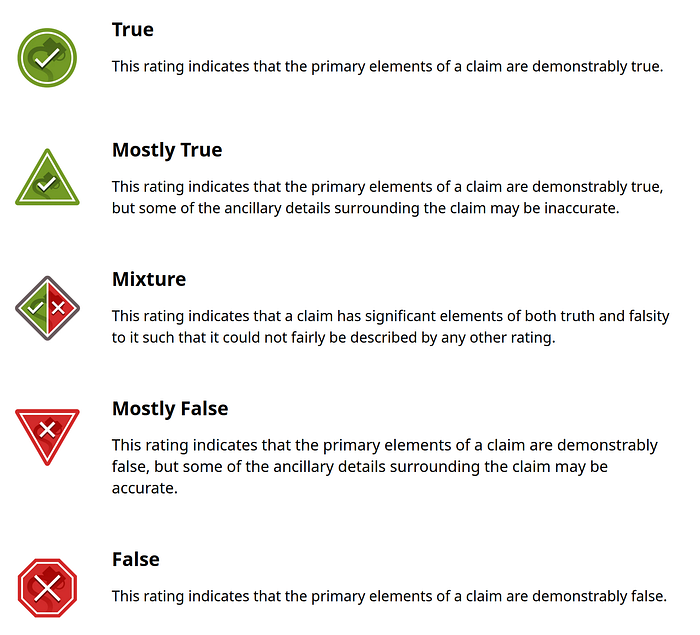
Yes, it is true that Linux offers a dizzying array of options and distros. That can be a lot to digest. But if you start with one of the distros that's designed to be easy to use and understand right out of the box, like Ubuntu, it's really not scary at all.
I'm not saying that Ubuntu is the king of Linux distros, but I think it sits in a nice sweet spot of flexibility and ease of use that both beginners and old professionals can both enjoy.
So what's true then?
I don't want to be like Kevin in my aforementioned anecdote and reply "just use Linux lol" every time someone mentions anything else, but I do think it has a lot of value for the average user these days.
It's not a scary operating system anymore, and honestly? It's pretty fun to use in my opinion.
At the same time, it's only fair to acknowledge that Linux is not for everybody. It's not. If you need certain software that's not available on Linux, like Adobe Creative Cloud or Final Cut or Microsoft Office, Linux isn't the right choice for you. There are alternatives, yes, but sometimes you just need a specific app, and that's that.
And I absolutely grant that certain things in Linux have a steeper learning curve than they do in Windows or macOS. Once you learn them, they can become second nature, I'd argue. But many people don't have the time or comfort to do that. And that's fine.
Linux isn't hard to use in my opinion, but that doesn't mean it's 100% grandma proof yet. That's something that will have to change before Linux can even think about challenging the dominance of macOS and Windows.
I think it's getting there though. And as more and more software supports or is supported by Linux as we're seeing, I think switching will make even more sense as Microsoft continues to drive Windows head-first into a dumpster.
At the end of the day, I think Linux has reached a point that it is not only a possible option but maybe even the best option for many people. Not everybody. And maybe not even for all things.
Since I switched though, forcing myself to get acquainted with the Linux way of thinking in more depth, I've been far more impressed than I thought I would be. Lots of things "just work." Some things I had to relearn. But through it all, I've had a lot of fun, and I can't recommend it enough.
Whether or not it's the right choice for you of course depends on the software you need to run and even your preferences. Some people just genuinely prefer macOS and Windows, and there are lots of great reasons for that.
But if you decide to not use Linux, at least make sure your decision is based in reality. You might be relying on outdated reasons just like I once did.
That said, there are a few things you need to consider before you switch. 👇